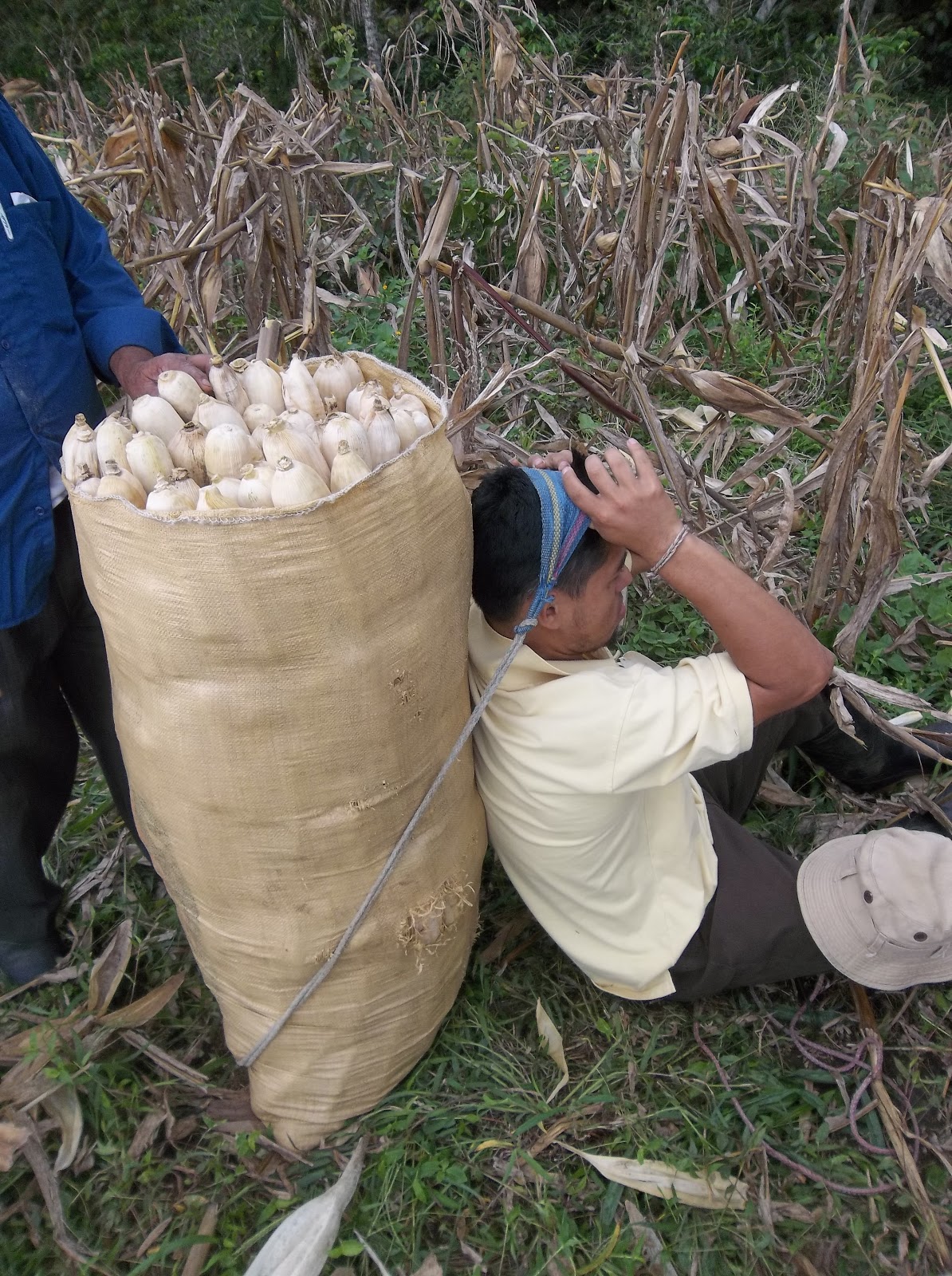
Wednesday, November 14, 2012

Una Empieza


I am beginning to develop a weekly routine, which is something I like.  My days are beginning to fly by, usually an indication that I am enjoying myself, which I would say all in all is true.  I have a 15 minute (about 1 km) walk from my host family’s home to the school farm.  I arrive at the school at 8 to start the morning.  Lately, before I know it, 12pm has arrived and I head back for lunch.  The afternoons are passing by rapidly too.  5pm arrives soon enough and I return to the Siquic home to cleanup and have supper.

The first activity of the month was organizing the tool shed at the farm.  This was a great job for the rainy days in the beginning of November.  I arranged things a bit more conveniently and found tools no one knew the school had.

One of those finds was an ancient reel mower.  It was rusted stiff, but I knocked it with a hammer and loosened it up.  Elias was standing by watching me and asked what the thing was.  “Macquina para cortar grama.”  (A machine to cut grass) I said, and pushed it across the lawn.  It worked, but was still sticking a bit.  “Necesita aceite.”  (It needs oil) I said.  Elias was ecstatic.  He left hurriedly and returned with old motor oil.  He proceeded to drench the mower, and unfortunately the surrounding lawn, with oil.  He got it working fairly well though and is happily using it around the school.  “El esta jugando.” (He is playing).  Oscar told me when he saw Elias with the mower.

 Old rakes make great machete racks!


We have repaired 10 shovels that needed new handles. 

We also have 7 hoes back in commission with newly selected handles.
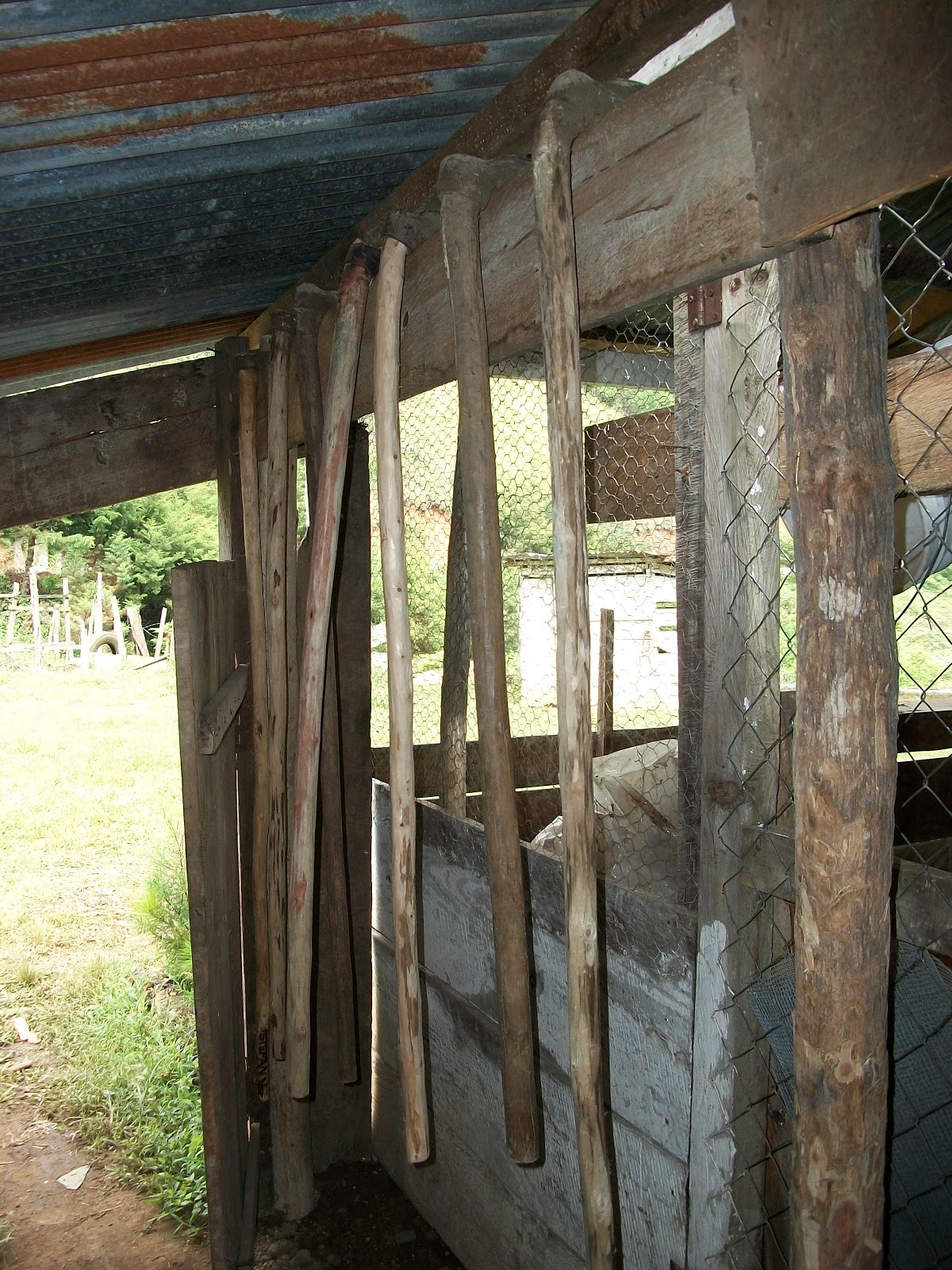
  
I happily selected a long handle for my own hoe.  I can now hoe with comfort, since I do not need to bend my back.  I do not understand why Guatemalans prefer to hunch over while hoeing.  It is very uncomfortable in my opinion.  They do not understand why I desire a long and straight handle.  So it seems that I have a hoe all to myself, which is fine with me.  Yet, to be sure, I engraved and burned my name into my hoe handle - just in case.

Making handles is an art.

Doing an engraving job.

I heated a wire in the evening cooking fire and burned my name into the handle.  Then I used a candle to seal my engraving with wax.

 Just a bit of new owner pride.


The farm now has 12, 5 gallon buckets.  Pedro, Oscar and I built a bucket rack to keep them organized and allow them to dry when wet.  They came in a stack and we had quite a time getting some of them unstock. Pedro, Oscar and I agreed to not stick buckets inside each other.


Oscar working on the rack.

Oh, the beauty of neatly organized buckets!


One of the first tasks with the newly acquired buckets was spreading compost.  It was much work for little gain, in my mind.  Scaling the hills was a challenge for me.  I need to repair the stairs down to the gardens.  Part way through the job, I slipped on the step slope and landed in a lemon tree.  After that, I left the nimble Guatemalans carry the buckets back and forth while I filled them.  “Este no es nada.”  (This is nothing) Oscar said and then told me about carrying two full buckets of cement up ladders during construction of one of the Bezaleel buildings.  My hat is off to that guy.  Nevertheless, in 3 hours time we only had 100 feet by 3 feet covered.  I need to think of a better system.  I bucket chain when the students are here would work.  Or a pulley system of buckets descending and ascending on a sky-lift like apparatus would be totally awesome!

One of my dreams for the farm came true this week.  I have been noticing the junk metal around the buildings and finding broken shovels and pick-axes while cleaning out the tool shed these past few weeks.  “It would be great to sell these to a scrap dealer and use the money to purchase seed for the farm.” I thought.  I was working on a plan for how to get them to the scrap dealer, when yesterday as I was about to leave for lunch, a scout from a metal recycler passed by and asked Oscar if we had any scrap to sell (I had told Pedro and Oscar that morning of my plan to turn the junk into seed).  Oscar asked me if I wanted to sell it to the guy for 50 cents a pound.  I asked if that was a good price and Oscar said it was not bad.  He tried talking the guy up to 80 cents a pound, but to no avail.  I told them it was better than leaving the metal sit around and rust away.  They agreed and we all helped to collect the metal strewn about the farmyard.  Now 124 pounds of scrap are off the farm and I have Q 62 to spend on more seed from the local market!

Quite a pile.


We are beginning to seed crops.  So far, peas, squash, cilantro, chard and red beets are in the ground.  It will be exciting to watch them grow!

Dew drops on a cabbage plant.

Planting Guisquil (a tasty squash) with Oscar and Pedro.

Plenty of compost to help them grow.


The first Sunday of the month, I attended the dedication of a new Mennonite Church at Chicujal.  It was a beautiful Sunday morning and as we marched to the church, the congregation sang a song in monotone harmony.  It was beautiful.

The church building itself was very nice, cement block and steel-roof construction, as is common in this locality.  The new congregation did not spare the sound equipment, as typical here among the Kekchi.  They boast sound equipment more advanced than in most of the churches in my hometown.  Why they need such projection equipment for a 50 by 30 foot building, I do not know.  I adjusted my earplugs as the praise team opened with their first song and tried to focus on worship.  This was very hard because even with the earplugs, the bass rattled my bones.  I am also not particularly fond of the style of music here.  The songs sound all the same and it is not because I do not understand the language.  They are usually in the same key and with the same pulsating rhythm.  The lead singer does more wailing than singing, in my judgment and there is very little congregational participation in the songs.  This is the same trend I have noticed in many churches in the States.  Congregations are losing the practice of singing.  I believe it is due to the type of music being played.  A band does not need audience participation for the song to be a success.  All the necessities for the song rely on the musicians in the band.  Accapella music on the other hand, relies totally on the audience to make the song a beautiful presentation.  What are we losing by adopting sound equipment and electric instruments?


The boys are in front of the subwoofers...


Anyway, while I was debating this in my mind, two boys, in the aisle to my right, motioned for my attention.  The one plopped a worm made out of the pine needles on my lap.  This is one Kekchi custom I totally love.  For celebrations, they carpet the floor with pine needles.  It gives a wonderful scent to the event and it is a totally renewable and biodegradable decoration!  Back to the worm, it was ingeniously created.  I walked it up and down my leg to the enjoyment of the boys.  That got my mind turning.  I gathered some pine needles and attempted to make a pine needle doll.  Unfortunately, it practically fell apart when I gave it to the boys, but they were delighted.  I then produced a dragonfly and rooster.  Two little girls behind me were watching and happily snatched these creations when I offered them.  By this time, the boys had made a second worm and attached the two in the shape of a heart.  This activity brought back memories of all the fun things my brother, Josef, and I made in the services and church functions we attended.  It is so fun to create things and I am glad to see that some Kekchi boys are flowing with creativity.  I hope they keep it up.

Two worms in the shape of a heart and a pretzel.

My creative friends.


Tomorrow, I leave for a bird watching camping trip with John Cahill.  Having put in four full weeks at the farm, I am ready for a change of scenery and expedition into the wilderness!

Thursday, November 8, 2012

Aprendiendo Nuevas Cosas


I have been having trouble with internet connections lately, so my apologies for the late update.  I will attempt to adopt a regular posting schedule, so my readers will know when to expect an update.  My goal will be to publish a new post the second and fourth week of each month.  This one covers up to October 28, 2012.

A highlight for me in the past 2 weeks was visiting La Finca Rubel Chahim, a preserve of cloud forest and demonstration farm operated by Rob & Tara Cahill.  Upon my first visit, I spent the morning watching birds with the Cahill’s son, John.  John is an excellent birder with the ability to identify countless birds by their call, coloration and flight pattern.  I saw many new birds that morning.  My favorites were the hummingbirds.  It so happens that property owned by the Bezaleel School, where I am serving as an agricultural instructor, is habitat for the Shear-tailed hummingbird, a rare bird in this area.  John took me birding there later in the week and we had a nice close-up look at one of the males in all his glory.

Beyond birding, I enjoyed the tour of the preserve and farm with the Don Bosco Catholic Boys School.  I was also able to assist with the agroecology center the Cahills are constructing.  This building will house classrooms, interns, labs and a food processing facility.

The agroecology center in process


Rob (Center) talking about sustainable agriculture, which cares for the cloud forest as well as feeding the village.

The cave

 The next day, I joined the Cahill’s interns on a tour of the Don Bosco campus near my town of San Juan Chamelco.  I especially enjoyed seeing the fields of guisquil (a tasty squash), malanga (or taro), yucca (cassava), camote (sweet potato) and maqui (a green of some kind) the school maintains to feed their 300 students.  My mind is full of ideas for starting the same at Bezaleel.  I am particularly fascinated by the root crop, malanga.  This is a starchy vegetable substitute for potatoes here in Guatemala.  Potatoes do not grow well in this damp climate and therefore require frequent fungicide treatments.  Malanga, on the other hand, grows prolifically without pesticides and once harvested, the stalk is replanted to grow another crop.  This crop reproduces itself, eliminating the need to purchase new seed.

Harvesting Malanga at Don Bosco

 A new field of Malanga


I am settling in with my host family in Chamelco and am enjoying getting to know the family.  I am staying with Alfredo Siquic, a former pastor and president of the Kekchi Mennonite Churches.  Alfredo and his wife, Albina, together with their five children currently living at home and me, make for an active household! One of the children is adopted, but I have not been told which one.  Wili is 19 and the oldest living at home.  He keeps busy with his guipil business; embroidering the blouses worn by the women in this area.  He can create amazing flower designs and at an amazing speed!   Mario is 15 and is enjoying his vacation from school by playing soccer as often as possible.  I have enjoyed some evening soccer games in the street outside their home.  Mariela is also 15 and together with her mother, makes tortillas 3 times as big as anyone else in Guatemala, from what I have seen so far.  They are great fresh and when toasted, taste like the best corn tortilla chips I have ever eaten.  Ingri and Axel are both 11.  I enjoyed a Sunday afternoon jog with them around the nearby school soccer stadium a week ago.  Alfredo Jr. is 9 and is usually at the house gate to welcome me back from the farm each evening.

Mariela and Axel in the kitchen
 La Señora tortiando
 (Left to right) Alfredo Jr, Axel and Ingri

Mario in his Sunday best.

Wili hard at work


Though there are no students at the school, I am busy getting the gardens ready for their return in January.  So far Oscar, Pedro and I have transplanted nearly 100 new banana plants for the coming years.

Planting Bananas with Oscar
 
Elias, Pedro and I built a second raised bed in the greenhouse for propagating transplants.  We have seeded Cabbage and Chile Peppers so far.

New raised bed on the left


Last week, Elias, Oscar, Pedro and I constructed composting bins.  The old ones are falling to pieces.  The school has been attempting to produce vermipost with red worms, but red ants move in and kill the worms.  Tara Katehill told me she has not had good experience with red worms for that reason and has discontinued using the method.  Therefore, Elias, Oscar, Pedro and I built three composting compartments.  We will follow Sir Albert Howard’s Indore Method for producing compost at Bezaleel and see how that goes.

Before

Building the composting facility with Pedro and Elias.


It may be crude, but I guess the compost will not care.  “Function over form.” as Joel Salatin says.  This was built entirely with recycled materials from old worm bins at the school.


In the coming weeks, I am looking forward to sowing vegetables for the coming school year.  I also hope to visit another demo garden operated by Medical Teams International, a Christian organization working to end the rampant malnutrition in this area of Guatemala.  The main problem health-wise in Guatemala is the same as that in the United States or anywhere else in the world: getting people to eat their vegetables!


Friday, October 12, 2012

Descubriendo Guatemala

What a week it has been!  It seems hard to believe that I have been in Guatemala for a little over a week.  So much has happened; it seems that I have been here for a longer time.

I arrived in San Pedro Carcha last Wednesday, after traveling a very scenic route through the mountains with long-term EMM workers, Galen and Phyllis Groff.  Find out more about the Groff’s work through their blog: http://groff-guatemala-missions.blogspot.com/

Last Friday, I left to spend time with Wilmar Caal and his family near Chiquixji, a remote little K’ekchi’ village.  Wilmar’s father, Felipe, works with a sustainable farming organization to improve farm productivity throughout Central America while caring for the natural environment.  The family grows coffee and cardamom as cash crops.  Maize, beans, and other vegetables and fruits are raised for their own sustenance.

Last Saturday, I was able to help harvest some of the family’s maize crop.  I was a fun morning.  I pulled ears off the stock, bent the stalk over (a sign that it was harvested), partially husked the ear and then hurled the ear through the air to a pile in the middle of the field.  I did that over and over again all morning.  Then the full ears were loaded into sacks (to a weight of about 150 pounds) and carried out to the pick-up truck.  All in all it was great exercise!


North Americans may say such harvesting is inefficient compared to modern self-propelled grain combines.  However, these machines cannot maneuver the steep slopes I did that morning.  Neither can a combine operator enjoy the sounds of nature, carry on a conversation with nearby workers or enjoy the breathtaking view I experienced while working.


On Monday and Tuesday, I participated in the harvest of cardamom.  It reminded me of picking strawberries in Pennsylvania: back-braking work.  A plus is that harvesting cardamom is in the shade; a minus is that, while eating a cardamom berry is excellent breath freshener, it does not compare to popping a vine-ripened strawberry into one’s mouth every so often while working. 


Besides fieldwork, I enjoyed the children I interacted with in the community.  Children too young for school, follow their parents into the field.  After he worked up enough courage to talk with me rather than simply smiling a cute smile while I asked him questions, I was able to have fun Spanish conversations with Chester, while harvesting cardamom.   I also enjoyed playing marble games and drawing pictures with Brian, Chester, Cristy and Litzy (not pictured) at the Caal's  home. 


At the K’ekchi’ Mennonite Church of Chiquixji, I was invited to play guitar with the musicians at the first service I attended and played in all the following services as well.  It was fun and I felt warmly received by the congregation.
 
 The first time I ever attended church in rubber boots!


I left my time with the Caal’s pondering their way of life.  I have been studying the book of Ecclesiastes this past week and conclude that all in all, the K’ekchi’ Christians may have a better grasp on the important matters in life than many Christians in developed countries.   For the K’ekchi’, family and friends are the most important.  Parents and grandparents are present to teach the younger generation; parents are present to hear the first words uttered by their children and share in their creative games and quest to explore the world.  Most modern parents have traded this exciting adventure for a “professional” career, permitting someone in a childcare center or the secular media to influence their children.
 
Felipe feeding the ducklings with his grandson, Brian.


Some other fun facts about my past week:  I finally have a guitar to play!  Wilmar and I went guitar shopping this past Thursday and we found a quality instrument for a reasonable price.  I am looking forward to playing it throughout my year here.

Wimar, testing a guitar in Coban.

My new guitar!

I can also add the American Redstart,


Azure-crowned Hummingbird,


Great Kiskadee,


and the Yellow-faced Grassquit to the list of new birds I have seen here in Guatemala.


Next week, I begin my preparation and plans for the coming growing season at the Bezaleel School.  I will be collaborating with some other workers who are involved in various agricultural programs throughout Alta Verapaz.  I am looking forward to getting out into Guatemalan agriculture!

Tuesday, October 2, 2012

Ya empieza mi aventura

I have finally arrived in Guatemala!  My dream of working in Latin America has begun... I remember days in the college classroom when sometimes, instead of listening to my professor, my mind would wander off into a land where I would work in agriculture and be forced to speak Spanish all the time.  It is hard to believe those dreams are coming true.  God is good.


My flights went smoothly and I had a nice taxi ride to Semilla, a guest house and Biblical education center operated by the Anabaptist Churches in Central America.  I have been relaxing and taking in the beauty of my immediate area.  Semilla is a beautiful campus.  I love the Latin American architecture that brings the outdoors indoors by including balconies and spacious porticos on every floor.  I have also noticed the abundant birdlife in the area.  There are many of the same birds here as in Pennsylvania, such as the Turkey Vulture (of course), Savannah Sparrow and Mourning Dove.  

Then there are other birds that mirror their Pennsylvanian cousins, 
including the Blue-Gray Tanager and White-winged Dove.


I was happy to get a close look at a White-eared hummingbird that loves the Yellow-Red Clock Vine flowers in the courtyard.  This morning one of these hummingbirds hovered within a foot of me as it collected gnats off of the shrubbery.  Good riddance- I- love hummingbirds!  


I have also been enjoying the people I am learning to know here.  Yesterday afternoon after a nap, I wandered down the stairs into the first floor balcony and found some boys playing ping-pong.  They eagerly invited me to join them.  I did and it was fun, although I had to divide my concentration between watching the ball and processing all the Spanish phrases they rattled-off at me.  A couple times I had to ask Angel, the fastest speaker, to repeat his questions to me more slowly, which he did with a smile and slight roll of his eyes.


Then this afternoon, I was chauffeured to a shopping mall to purchase some necessities before leaving the city.  I enjoyed the trip and the neatness present in much of the city.  Multiple times I saw city workers sweeping the litter off the side walks and the mall had two workers caring for a rose garden.  There are recycling receptacles everywhere.  Though the city is interesting, I am eagerly looking forward to traveling into the countryside and seeing more agriculture.  That trip will begin tomorrow, Lord willing.  I will inform you all how it goes.