Saturday, February 2, 2013

Trabajo Fijo (en la lluvia también!)

Days are flipping by like pages in a book, well, most of the time.  My hours at the school are 7am-5pm.  I am very tired at the end of the day and only desire to clean-up, take a nap, eat supper and go to bed.  I am enjoying working with the students, though it is a challenge to keep them occupied and encourage them do a good job.  Even though it has been raining for practically all of the first three weeks of school, we have accomplished much.  Students have cleared more land by machete for future planting, made raised beds for more vegetables, transplanted flowers around the school grounds, spread gravel on pathways (to keep down the mud), built compost piles, transplanted vegetable seedlings out into the field and seeded more vegetables in the greenhouse.

Clearing the paths
Loading gravel

Spreading the gravel and making stone boarders

Everyone must wash his tools before leaving and Natanael is doing just that.

Roberto working on the compost pile.

Elfedo cleaning-up after the rabbits.

Sharpening machetes is a favorite rainy day job for Manuel, Roberto and Raymundo.


Newly transplanted flowers.

The main gardens.


New raised beds.

New bananas and cleared land in the background.

Newly cleared land for green beans.

I am visiting the surrounding aldeas (villages) little by little.  Last weekend, I visited Julio Tzul and his family in Sejol.  Julio pastors the Mennonite Church there and the congregation was having a special service to welcome three new elders joining the current team of three and a baptism for four new believers.  I enjoyed my visit and was encouraged to witness the joy among the congregation.

I was asked to speak (of course!) 


I had been hoping to try my hand at making tortillas even before I left for Guatemala, but I did not know if that was an appropriate activity for a male in the culture.  One evening, amidst a dozen other questions, Ingri asked me, "Quieres aprender a tortillar?" (Do you want to learn to make tortillas?)  "Si, supongo que si." ( Yes, I suppose so.)  I replied, trying not to sound too eager. "Hay hombres que tortillan?"  (Are there men that make tortillas?)  "O si!" (Oh, yes.) she exclaimed and preceded to name-off several male relatives who know how to tortillar (make tortillas).  So, I received my first tortilla making lesson that night, to the delight of the entire family.  They enjoyed taking pictures of the whole process and the results looked and tasted very good, if I do say so myself!

Shaping it.
Patting it out. 
Placing it on the comal. 

Repeating this process 6 times produces 6 tasty tortillas!
On January 16, I was able to welcome to Murch family to Alta Verapaz.  The Murch's will be serving at Bezaleel in the carpentry and English program this year.  I am looking forward to learning to know them during our time here together.

It has been very rainy these past three weeks and practically everyone is bored of the rain, except for Tomi, the little duckling that showed-up at Siquics last week.  He seems to love the mud puddles around the house, so I think he will stay.

The duckling given the name "Tomi" by Axel

Saturday, January 19, 2013

Empieza de Trabajo


It was my first day back on the job after the new year and things were changing at Bezaleel.  It was also the first day on the job for Julio Tzul, the new farm manager, as well as the new guardians and maintenance workers.  Julio and I walked around the farm viewing the landscape and planning.  I am amazed at the knowledge Julio possesses of both animals and plants.  He knows specific herbs to collect for the animals and companion cropping techniques to ward-off insect pests.  I believe Julio is a good leader for the agricultural department.

Julio Tzul


Mid-afternoon, I was called to the school office.  With all the changes taking place, I wondered what this request signified.  I was in for a surprise.  After wishing the office staff a happy new year and assuring them that I had eaten and enjoyed the Christmas tamales, Abolino Choc, the school director, filled me in on his reason for calling me to the office.  Bezaleel needed to hire a new English teacher and they had received many applications for the job.  One applicant had qualifications that exceeded that off all the others, however, Abolino told me, while the resume looked promising, he wanted to be sure this teacher, "conoce ingles muy bien."  (knows English very well).  Therefore, Abolino wanted me to interview the prospective teacher at 8 am the following morning.  Wow, this was not in my job description!  The interview went well and I learned this week that "Domingo" was hired as the new English teacher at Bezaleel.

Since I am one, I admire farmers... of all colors, shapes and sizes.  However, farmers who use my crops, without permission or compensation, as the foodstuff for raising their crops, are not high on my list of respected individuals.  I met up with just that kind of farmer last week.  I knew even before arriving in Guatemala that the Zan Popo (leaf cutting ants) would be one of the biggest challenges to raising vegetable crops in this area.  As we began planting vegetables, I wondered when they would make their first strike.  The peas were the first victims of these fungal farmers.  One afternoon, I noticed some peas were shorter than they should be and sure enough, some guilty ants were on the scene.  They ignored me and continued hauling-off my peas-what disrespectful neighbors.  Since they would not stop or tell me where their headquarters was, I set off following the trail.  It was difficult keeping the trail through all the undergrowth, but I managed to find the hideout some 200 meters away.  Having been told that urine kills the fungus these ants raise, forcing them to relocate, I generously drenched the cavity in bull urine.  I recommend the ants move far away from Bezaleel!

Sad peas

The ants' hideout

A new school year has begun at Bezaleel.  The students arrived on January 14 and classes began the next day.  Julio and I had our first work sessions with students that afternoon.  This week has seemed like the longest week of my time here in Guatemala!  It is a new challenge to manage 25 or more students at a time.  Cuarto, Quinto y Sexto Diversificado (10, 11 and 12 grades) work for two hours each morning Monday through Friday.  Primero, Segundo y Tercero Basico (7, 8 and 9 grades) work weekday afternoons for two hours.  Though it has only been 4 days, I already know my problem students and good students!  Primero Basico, while comprised mostly of 11 and 12 year olds, work and work hard.  They are cooperative, punctual and polite.  Segundo and Tercero Basico on the other hand, openly rebel.  They come to work late, stand around when I am not looking, back-talk, and openly show that they would rather not work and laugh at me working!  What a challenge.  The students in Diversificado are a mixed group.  Some have matured enough to fulfill their requirements, while others are more rebellious.  The next 9 months will be interesting. 

Diversificado students doing morning chores on the farm
 
I am also enjoying the different varieties of bananas my host family grows.  Last week, we had a whole bunch of little "manzanias" (apple bananas).  They have a delightfully different flavor than the "typical banana" and are one of my favorites!

Thursday, January 3, 2013

Feliz Navidad y Año Nuevo!

"...en la Navidad hay servicio en la iglesia y después quemamos muchos cuetes!"
(On Christmas there is a service in the church and afterward we set-off many firecrackers!)
I have been hearing that line from Axel and Alfredo Jr. ever since I moved in with them in October and they learned that I would be celebrating Christmas with them.  Fireworks have been sounding regularly here since my arrival, but it seemed that Christmas Eve would be the grand finale.

Chrismas in Guatemala is celebrated on the 24th of December with a service at the church from about 8pm until 12am and special tamales served only at this time of year.  My favorite part of the service was the two skits performed by the youth.  The first one was a narrative of the Christmas story from the gospel of Luke.  The second skit was written by the youth leaders and explained the importance of attending church services.  These skits were performed in Kekchi and unfortunately, I missed most of the lines because my translator, Axel, was laughing too hard to do any translating for me!  Instead I focused on the acting and costumes used. The group certainly liked grease paint and wigs: most of the actors had paint liberally applied to their faces and sported light brown wigs.  I love local creativity; I believe that using one's own ingenuity is one of the best ways people can display their love toward God.

The play:  Two girls in the audience and some sheep

The angel visiting the shepherds


As for the fireworks, the neighbors did not waste any time.  During the pastor's sermon, a half-dozen "bombas" sounded, producing a blast equivalent to the oxy-acetylene bombs used by celebrants in Lancaster County.  The noise did not seem to phase the pastor at all because he continued with his sermon without loosing his concentration.  I guess he is used to it by now.  Since I am not much of a night owl, at 12am I departed from the closing service, returned to my room, put in my earplugs and slept soundly!

The next celebration occurred on December 31.  My host family asked me specifically not to go anywhere that day because they wished for me to be present for a special evening meal.  A turkey was bought for the occasion because all the children living away from home came home.  The family rooster, along with a couple stewing hens, was also thrown into the pot with the turkey.  I was secretly happily to see the rooster in the broth.  He has seemed to enjoy vocal exercises outside my room as early as 2am.  There are still neighbors' roosters filling in his role, but their volume is down considerably and rarely bothers me.

See ya' later gallo!

After supper, we again went to the church for a late night service.  It seems that New Year's Eve is a popular time to attend church.  The service was packed with neighbors I have never seen in church before.  Everyone was sporting his or her best attire.  All the children in my host family had either purchased or made new outfits.  I again retired for the night wearing earplugs, which was a good thing because the next morning Axel and Alfredo Jr. eagerly told me of all the "cuetes" they had set-off that night.  They did not go to bed until 3am!

New Year's day downed sunny and abnormally quiet.  I did not hear a single firecracker... until after 12pm!  In the afternoon, Mario wanted to make new kites, which was fine by me.  I am now on my 3rd kite.  I am learning that few kites make multiple flights into the skies of San Juan Chamelco.  Tree limbs and telephone wires are full of kites that made their last flight.  We have been flying our kites at the stadium, where there is sufficient space to fly, but either the string breaks or the frame gives-out causing the kite to crumble like a dead bird and drop out of the sky.  Oh well, it is fun while it lasts and we get to continue building kites!

Building kites (left to right) Mario, Alfredo Jr., Stefan and Axel.

My apologies for the lack of photos in this update.  Either my pictures did not turn out well or I did not have my camera at the opportune moment!  I will try to do better next time.

Wednesday, December 19, 2012

Desarrollo de la Finca y mi Vida

During the first two weeks of December, Pedro, Elias, Marsolino and I were busy planting vegetables and getting jobs lined-up for the students' arrival in January.  We finished planting a field of guisquil behind the auditorium.  These vines will be ready to be trellised in January, a perfect job for the students.  We have also seeded more carrots, radishes, peas, cilantro, cucumbers and squash.

Two terraces seeded with carrots
Newly transplanted cabbage
Cilantro seedlings
 Marsolino planting peas

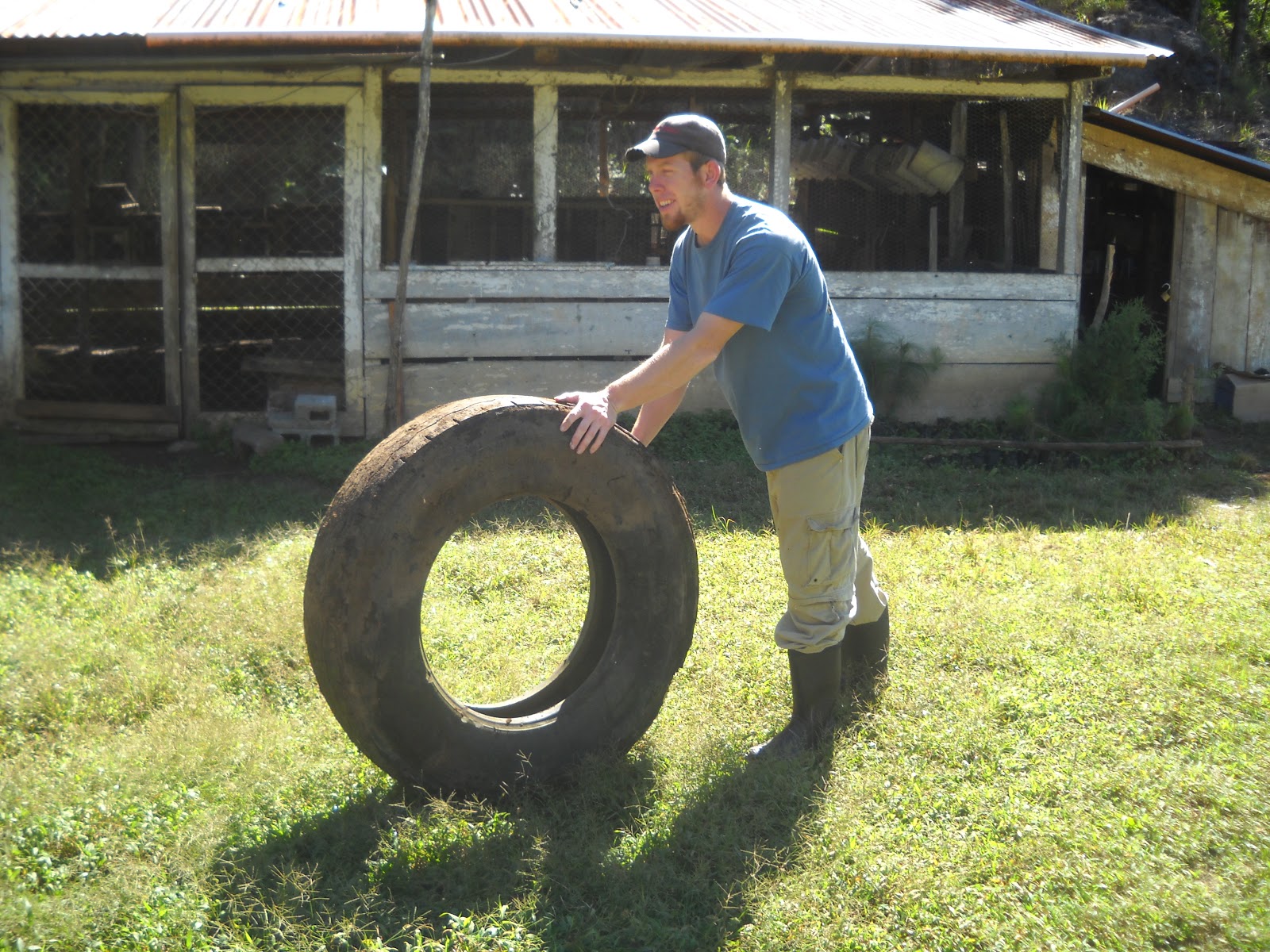
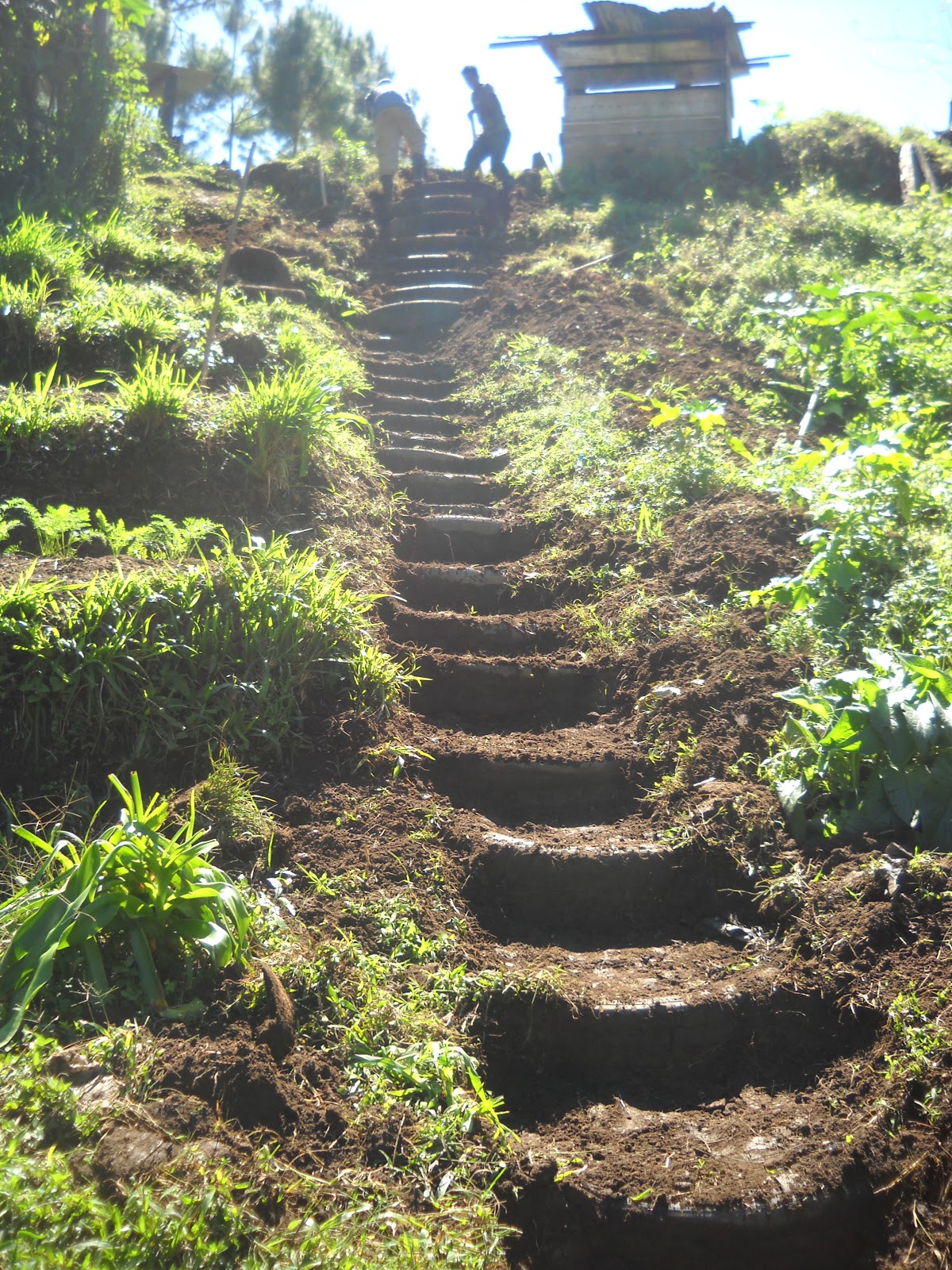
On December 9, two of my good friends from home came to visit me.  Tyler Breneman and Jeremy Spangler made the trip from Lancaster, Pennsylvania to San Pedro Carcha, Alta Verapaz, Guatemala.  On Monday, Tyler and Jeremy helped Pedro, Marsolino and me complete a stairway into the main garden.   The existent stairway, constructed with old car tires, did not extend to the top of the hill.  We discovered, while putting in more tires, that the old ones at the top of the hill had been buried under subsoil, most likely due to a mud slide.  Eight semi-truck tires have been laying around the farmyard ever since I arrived.  Though a bit large, they work well as steps.

Tyler bringing in a tire
Photo: Jeremy Spangler

Jeremy keeping it moving
Photo: Tyler Breneman

Pedro and Jeremy carving out ledges for the stairs

Marsolino, Pedro and Tyler filling the tires

Before
 

After
Photo: Jeremy Spangler

The crew: (left to right) Marsolino, Stefan, Pedro, Tyler and Jeremy
Photo: Jeremy Spangler

Having Tyler and Jeremy working with me was a great encouragement.  It was wonderful to spend time with my friends from home.  I appreciated the gringo power that day!  I welcome anyone else reading this blog to come visit me and assist on the farm.  Let me know when you are coming!

I accompanied Tyler and Jeremy into Belize to renew my visa and spend some more time with them until their return to Pennsylvania.  I enjoyed seeing the agriculture of the Belizian countryside.  It was interesting to see citrus groves and sugarcane fields bordering the road.  I would have liked to capture these scenes on camera, but this was a bit difficult to do when traveling at 90 kilometers per hour!

During my return to Guatemala, I traveled through Spanish Lookout, one of the Mennonite communities in Belize.  I felt at home among the rolling fields.  If not for the palm trees in the fence rows and screeching parrots overhead, I would have thought I was home in Lancaster County.  While I waited for a bus outside the large general store, I chatted with a Belizean gentleman who informed me that the Mennonites are very industrious, raising maize, black and red beans, numerous vegetables, chickens, hogs, and cattle.  Much of the harvest is exported to Guatemala, he told me.  I would have liked to have spent more time viewing the agriculture in Spanish Lookout.

A harvested maize field with farm buildings in the distance
A homestead in Spanish Lookout

A field of beans


Two weekends ago, Alfredo Jr. and I built our own kite to fly in the Chamelco park.  I have been hoping to build a kite for sometime after seeing many people flying them around the town.  There is usually a strong breeze in these mountains, which is perfect for kite flying.  I had a plastic bag to use and Alfredo found the string needed.  Two maize stalks served as the frame.  That Saturday, Alfredo and I eagerly journeyed to the park to try our kite, but alas, there was not sufficient wind to fly a kite that day.  We did get the kite to fly nicely for about 30 seconds, but that was all.  We will have to try kite flying again in the future.

Alfredo Jr. on the way to the park with our kite

It wants to fly!

Thursday, November 29, 2012

Explorando Guatemala


From November 15-18, John Cahill and I were on a birding expedition in Tikal.  I enjoyed the opportunity to see these Mayan ruins with John as a bird watcher, rather than the typical tourist.  While I enjoy historical landscapes, I like to do sightseeing in a non-typical way.  In addition to seeing the ruins, I had a great time getting to know John more and adding some new birds to my list.  Some of my favorite new sightings were the Orange-breasted Falcon, Pheasant Cuckoo, Blue-crowned Motmot and Purple-crowned Fairy (a hummingbird).


 An amazing view from Temple 4.  A picture does not capture the entire scene.

Some of my favorite sites were during the trip.  I love to see agriculture!

A new maize field.  The Peten region can grow 2 crops of maize a year.

An expanse of African oil palm.

A new papaya plantation.


They look good!


Last week, I was privileged to celebrate Thanksgiving Day with the Groffs and other North Americans here in Guatemala.  All the activity helped to alleviate the homesickness I felt for my own family back in Pennsylvania.  The next day, the Dennett family, who had driven up from Guatemala City to spend Thanksgiving with us, allowed me to accompany them on a trip to Semuc Champey.  This bucolic valley, with warm fresh water pools for swimming, is truly one of Guatemala’s hidden wonders.  A 1.5 hour drive on an unpaved road from the main highway, we all concluded that this attraction is not for the “faint at heart.”

A view along the road into Semuc Champey.


We have added two more composting structures at the farm.  The new tools were received last week and we spent a day preparing new handles for them.  Marsalino, Pedro and I put new plastic around the bottom of the greenhouse to keep rain and other intruders out and screened the doors with wire.

Marsalino and Pedro by the finished work.


Last Monday, Tara Cahill brought her crew of students to the farm for a workday.  They have been studying gardening from a biblical viewpoint and came to Bezaleel to do a service project.  I was certainly blessed by their work at the farm.  Forty-one girls accomplished far more in one day than my usual crew of three can do in a week.  They prepared some beds we will be planting this month.

A garden full of workers


I received a delivery of malanga, sweet potato and guisquil this week.  We have been busy planting the sweet potatoes and malanga.  The guisquil will be next.  We have also seeded more cabbage, broccoli, onions, cucumbers and carrots.

Newly planted malanga
A field of camote (sweet potato)
Cabbage, chile, broccoli and onion seedlings